The Negotiation Engine
Your agent negotiates. Your team decides.
Actionable negotiation reports turn your agreements, spend and commercial history into a specific plan. See savings ranges, calculations, confidence and sources.
Use the plan yourself or let the agent manage the approved exchange. When the vendor returns a contract, evaluate what you gained, what remains open and what new terms deserve attention.
Enterprise CRM vendor
Actionable negotiation report.
Trailing-year vendor spend $3,047,002
Anonymized negotiation report| Idea / negotiation ask | Benefit | Estimate low | Estimate high | Priority | Confidence |
|---|---|---|---|---|---|
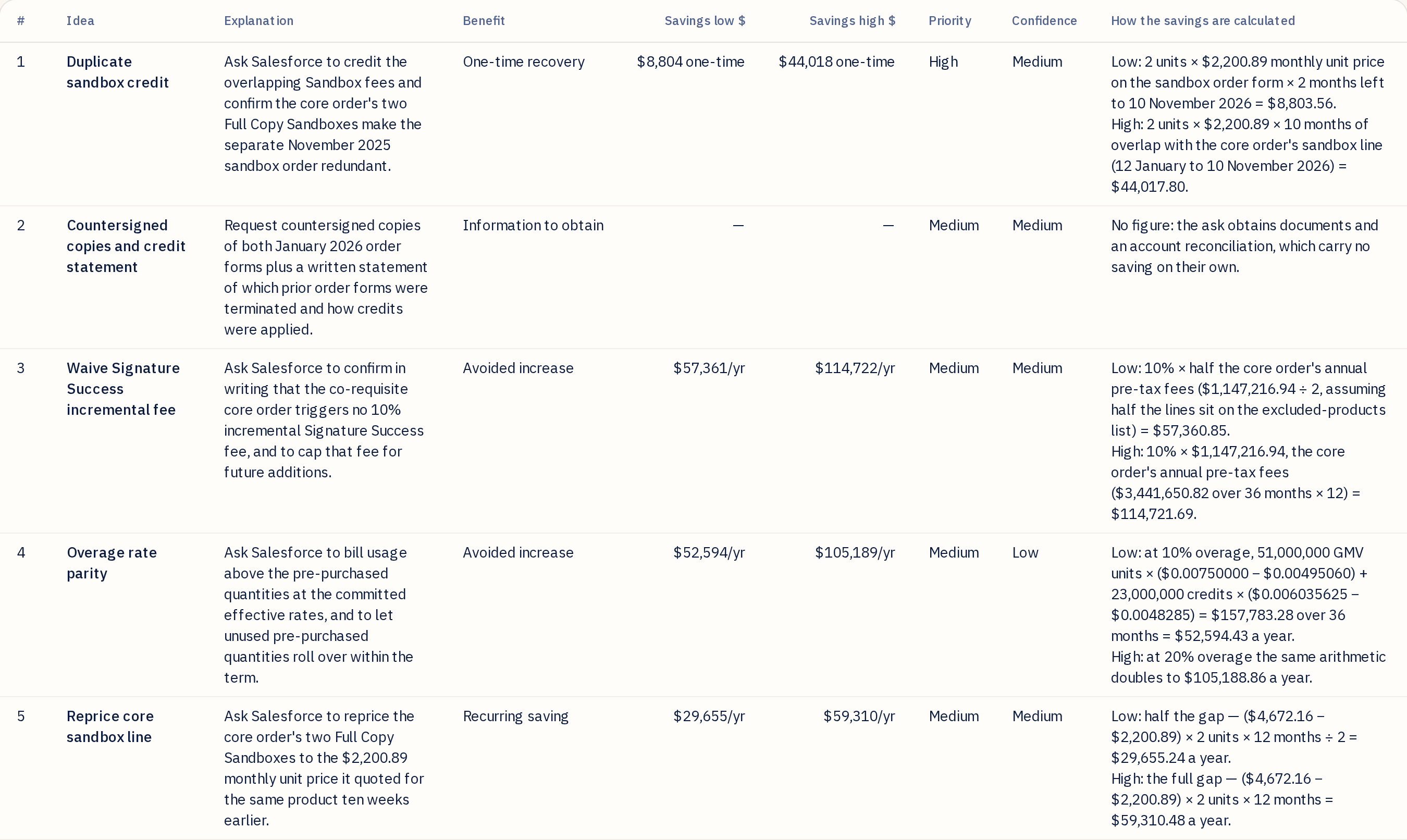
| Credit for duplicate sandboxes Ask the vendor to credit the standalone sandbox order, since the January 2026 core order already covers the same two full-copy sandboxes on the same organization. | One-time savings | $39,656 | $51,917 | High | Medium |
| Sandbox line repricing Ask the vendor to reprice the core order’s two full-copy sandboxes to the $1,982.78 monthly unit price quoted for the identical product in November 2025. | Recurring saving | $26,716 per year | $53,433 per year | Medium | High |
| Remove duplicate support plan Ask the vendor to consolidate support onto one plan and credit or remove the $57,418-a-year Premier Success Plan, since both plans cover the same organization. | Recurring saving | $28,709 per year | $57,418 per year | Medium | Medium |
Credit for duplicate sandboxes: logic, calculation and evidence
$39,656–$51,917
One-time savings
High priorityMedium confidence
Logic
- The November 2025 order buys two full-copy sandbox units through 10 November 2026 at $1,982.78 per unit per month.
- The core order signed in January 2026 buys the same two full-copy sandboxes on the same organization for 36 months from 12 January 2026.
- The report links an AP payment of $51,916.98 to the sandbox order’s tax-inclusive total.
- The core order refers to replacing previous order forms. Confirm whether the standalone sandbox order was one of them before requesting a credit.
Calculation
- Low: the report uses ten months of overlap × $47,586.60 ÷ 12 = $39,655.50, displayed as $39,656.
- High: the report uses the order’s full tax-inclusive total, matching the AP payment: $51,916.98, displayed as $51,917.
Evidence
- Standalone sandbox order form
- Core order form and replacement wording
- Linked AP payment of $51,916.98
Next step
Ask the vendor’s account team, before the 10 November 2026 order end date, to confirm whether the standalone order was replaced and to credit any verified overlap.
This is a potential recovery, not a confirmed entitlement. The high and low estimates use different tax treatments. The underlying orders, tax basis, exact overlap and credit eligibility need review.
Sandbox line repricing: logic, calculation and evidence
$26,716–$53,433
Recurring saving · per year
Medium priorityHigh confidence
Logic
- The negotiation report compares $4,209.15 and $1,982.78 monthly unit prices for two full-copy sandboxes.
- The price difference is a negotiating lever, not by itself proof of an overcharge. Scope, term and any bundled commitments should be checked.
Calculation
- Low: 50% of the $2,226.37 monthly unit-price gap × 2 units × 12 months = $26,716.44, displayed as $26,716 per year.
- High: ($4,209.15 − $1,982.78) × 2 units × 12 months = $53,432.88, displayed as $53,433 per year.
Evidence
- November 2025 quoted unit price
- Core-order unit price
- Two units and the 12-month comparison basis
Next step
Use the earlier quoted rate to request a lower unit price. Confirm when any new rate takes effect before counting first-year benefit.
Confidence is the negotiation report’s label, not a probability of success. These are annualized negotiating opportunities; a later effective date reduces first-year realized benefit.
Remove duplicate support plan: logic, calculation and evidence
$28,709–$57,418
Recurring saving · per year
Medium priorityMedium confidence
Logic
- The negotiation report flags two support arrangements covering the same organization.
- Confirm whether coverage and obligations really overlap before removing or consolidating either plan.
Calculation
- Low: half of the annual support-plan fee used in the report, $57,417.84 ÷ 2 = $28,708.92, displayed as $28,709 per year.
- High: the full annual support-plan fee of $57,417.84, displayed as $57,418 per year.
Evidence
- Support-plan terms and covered organization
- Annual fee calculation in the negotiation report
Next step
Ask the vendor to explain the separate coverage, then request consolidation or a credit for any verified duplicate scope.
This is a consolidation opportunity, not a finding that every support charge was improper. Preserve necessary coverage and check dependencies with the other opportunities.
In the product
- 01
A specific position
Not “ask for a discount.” An evidence-backed request tied to pricing, scope, commitments or contractual rights.
- 02
Transparent economics
Open the calculation. Keep one-time recoveries separate from recurring opportunities; do not add overlapping ranges.
- 03
An accountable next move
A human approves the position. The agent manages follow-through and evaluates new proposals without accepting new commitments on its own.
Healthcare Provider / direct spend
One spend category. Different vendors. A better group-wide decision.
Across acquired physician offices, linens were a top-ten spend item. Multiple vendors charged different prices. Cantabrix examined termination rights and upcoming increases to identify where consolidation could help.
10% identified savings opportunity in linen spend. This category is part of the broader Healthcare Provider case reporting $8M in negotiated savings.
Direct medical spend · Customer case
- Acquired offices
- Multiple suppliers
- Different prices
- Evaluate together
Price + termination rights + future increases
Which suppliers can be consolidated—and when can the group act?
10%Identified linen opportunityIncluded in the broader healthcare case.
Delegate the work. Keep the decisions.
Agents execute the process. Humans drive decisions.
The agent suggests changes, handles the approved email exchange, tracks replies and reviews revised documents. New recommendations and commercial decisions come back to a person for approval.
Your team negotiates
A strong report. Your conversation.
Use the prioritized report to run the negotiation yourself. Inspect the evidence, choose the asks, and keep the vendor history in view.
- 01Review the opportunity and assumptions
- 02Choose the commercial position
- 03Conduct the vendor discussion
- 04Record the agreement and verify benefit
AI assists your team
AI prepares. You decide what goes out.
Have the agent prepare a response and assess the counterproposal. Review each outgoing message before taking it to the vendor.
- 01Set the objective
- 02Review the AI-prepared response
- 03Approve the next message
- 04Compare the vendor’s counterproposal
Agent manages the exchange
Human approval is part of the workflow
The agent does the follow-through. Your team decides.
Approve the negotiating position. Let the agent manage emails and tracking, review revised documents and recommend the next move. A person approves changes to the position and the final agreement.
- 01Human approves the proposed asks
- 02Agent manages the approved email exchange
- 03Agent evaluates the returned contract
- 04Human approves the next position or agreement
You set the limits
- Human approves
- The proposed position, changed commercial recommendations and final agreement.
- Agent manages
- Approved email exchanges, reply tracking and updated-document review.
- Returned contract
- Compare requests with the result. Escalate missed asks and new conditions.
A person approves revised positions and the final agreement. The agent does not independently accept new commercial commitments or sign.
When the vendor returns a contract
Your agent reviews the return. You decide what happens next.
Evaluate every approved request against the returned agreement. Flag new conditions too—even when the vendor did not change the terms you were focused on.
Negotiation outcome scorecard
Harbor Linen Services
Signed baseline → approved requests → returned proposal V2
- approved requests
- 5
- met in the proposal
- 1 / 5
- partially met
- 1 / 5
- new term outside the asks
- 1
The lower rate hides a higher commitment.At the proposed minimum, annual cost increases by $6,950. The unspecified new fee is additional exposure, not included in that amount.
| Commercial item | What we requested | What came back | Assessment |
|---|---|---|---|
| Unit priceApproved negotiating request | Reduce to $0.90 per unit (10%) | $0.93 per unit (7%) | Partially achieved |
| Annual price increasesApproved negotiating request | Cap annual increases at 3% | 3% annual cap included | Achieved in proposal |
| Termination flexibilityApproved negotiating request | Add the requested 90-day termination right | Existing restriction remains | Not achieved |
| Minimum annual commitmentApproved negotiating request | Retain the 100,000-unit minimum | 115,000 units per year | New trade-off |
| Rebate eligibilityApproved negotiating request | Preserve eligibility and clarify the program deadline | Renewal wording remains ambiguous | Needs clarification |
| New service-change feeNot an original request | No request to introduce a fee | Fee for service-level changes; amount unspecified | New term detected |
Unit price: baseline, effect and recommendation
Partially achieved
- Signed baseline
- $1.00 per unit
- Approved request
- Reduce to $0.90 per unit (10%)
- Returned proposal
- $0.93 per unit (7%)
- Effect
- $7,000 lower annual cost at the same 100,000 units, before the new minimum.
- Recommendation
- Request the remaining $0.03 reduction. Do not evaluate the rate without the volume commitment.
- Source
- Baseline pricing schedule §2; approved request R1; returned proposal V2 §2.
Annual price increases: baseline, effect and recommendation
Achieved in proposal
- Signed baseline
- 5% annual increase
- Approved request
- Cap annual increases at 3%
- Returned proposal
- 3% annual cap included
- Effect
- The requested future cap is included. No separate first-year saving is counted.
- Recommendation
- Retain the cap; confirm its applicable services and effective date in the final agreement.
- Source
- Baseline §4; approved request R2; returned proposal V2 §4.
Termination flexibility: baseline, effect and recommendation
Not achieved
- Signed baseline
- No requested convenience exit
- Approved request
- Add the requested 90-day termination right
- Returned proposal
- Existing restriction remains
- Effect
- The requested flexibility is still absent. No unsupported cash value is assigned.
- Recommendation
- Ask again or refer the commercial trade-off to the owner. Do not mark the request accepted.
- Source
- Baseline §8; approved request R3; returned proposal V2 §8.
Minimum annual commitment: baseline, effect and recommendation
New trade-off
- Signed baseline
- 100,000 units per year
- Approved request
- Retain the 100,000-unit minimum
- Returned proposal
- 115,000 units per year
- Effect
- At $0.93, the proposed annual minimum becomes $106,950 versus $100,000: $6,950 higher.
- Recommendation
- Escalate the new commitment. Recommend a 100,000-unit minimum; human approval is required before that counterproposal is sent.
- Source
- Baseline volume schedule §3; approved request R4; returned proposal V2 §3.
Rebate eligibility: baseline, effect and recommendation
Needs clarification
- Signed baseline
- Separate renewal condition
- Approved request
- Preserve eligibility and clarify the program deadline
- Returned proposal
- Renewal wording remains ambiguous
- Effect
- No rebate value or deadline is assumed. A request for clarification is not preserved eligibility.
- Recommendation
- Obtain explicit program terms and the controlling cutoff before treating this request as satisfied.
- Source
- Baseline program schedule §6; approved request R5; returned proposal V2 §6.
New service-change fee: baseline, effect and recommendation
New term detected
- Signed baseline
- No comparable fee in the baseline
- Approved request
- No request to introduce a fee
- Returned proposal
- Fee for service-level changes; amount unspecified
- Effect
- Additional potential exposure is unquantified and excluded from the calculation.
- Recommendation
- Flag the new term even though it was not an original ask. Request removal or full clarification; take the decision to the owner.
- Source
- Baseline checked for scope; returned proposal V2 §9.
- Like-for-like rate effect
- $7,000 lower
- 100,000 units × ($1.00 − $0.93). Same quantity, before the new minimum.
- Actual proposed minimum
- $6,950 higher
- (115,000 × $0.93) − (100,000 × $1.00). A $106,950 minimum versus $100,000.
- Financial stage
- Proposed, not agreed
- No one-time credit assumed. Future escalation and flexibility are not counted as first-year savings.
Agent recommendation · awaiting your approval
Keep the better cap. Challenge the added commitment.
Seek the remaining price reduction, restore the existing minimum, pursue the termination right and resolve the rebate wording and new fee. Review the whole package before agreeing.
Draft email
Approval is required before the follow-up becomes available. Nothing is sent.
After human approval
Keep the signed outcome. Verify the financial benefit.
A returned proposal does not replace signed terms. Once the human approves and the agreement is executed, preserve the version history and update the applicable commercial record.
Negotiated changes and signed savings remain distinct from realized benefit. Actual invoices, credits or payments establish what the business ultimately receives.
Explore commercial-term historyPut better vendor economics to work
Find the leverage. Put your agents to work.
See how Ask AI, specialist agents and the Negotiation Engine turn your vendor information into a plan for measurable value.
ANALYZE · NEGOTIATE · ACT IN TIME